
Inside The Music
1962 was a great year for pop instrumentals, with classic recordings like 'Wonderful Land' and 'Nutrocker' topping the charts. Greatest of them all was the mighty 'Telstar', written and produced by Joe Meek and performed by the Tornados. In this sound clip Dave deconstructs Telstar's unique sound and explains how Joe Meek and The Tornados created the sound of the future!
Telstar Deconstructed by Dave Stewart
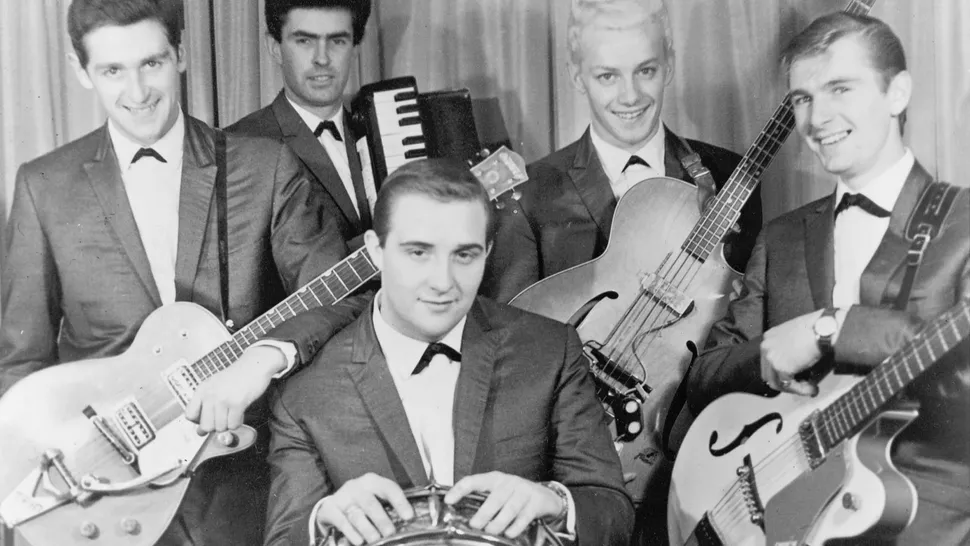
The Tornados. L-R: guitarist George Bellamy, keyboardist Roger LaVern, drummer Clem Cattini, bassist Heinz Burt and guitarist Alan Caddy.
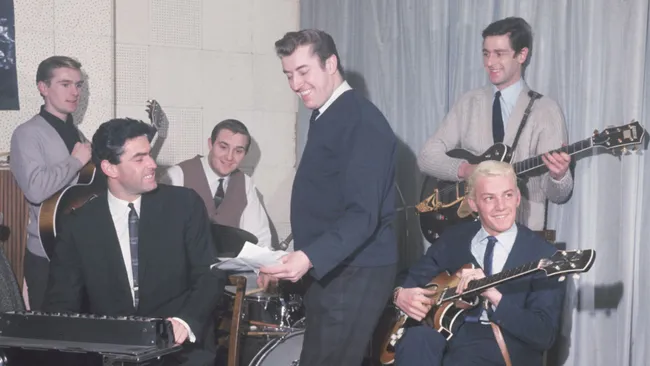
The Tornados with Joe Meek. L-R: Alan Caddy, Roger LaVern, Clem Cattini, Joe Meek, Heinz Burt, George Bellamy.
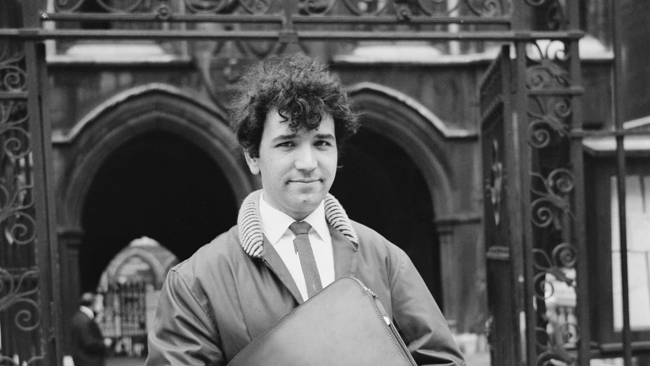
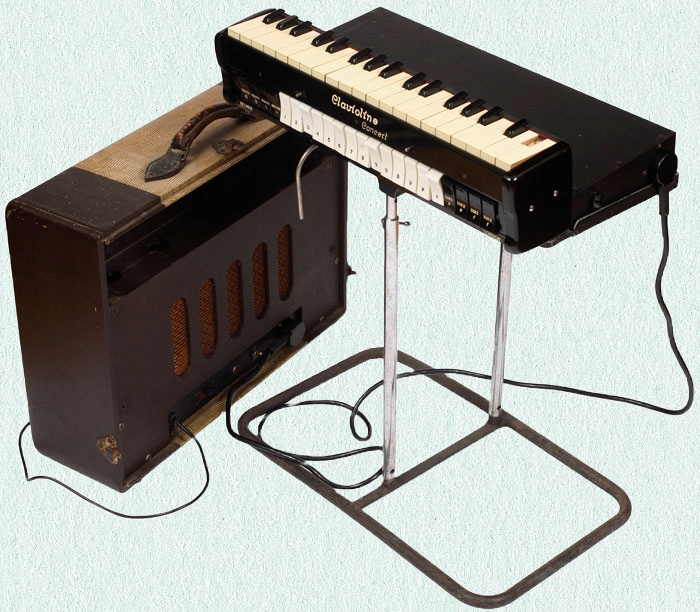
Pictured above: Geoff Goddard, the Clavioline.
M u s i c i a n s ' N o t e s
Dave Adams began working with Joe Meek in 1958 and continued to work with him until Meek’s death in 1967. In the early 1960s he helped build up Meek’s studio, wrote songs for him and also recorded singles with Meek under various pseudonyms.
According to Dave Adams, "'Telstar' was born at a late night demo session with just Joe and myself. In his inimitable way he sang the melody in the usual, atrociously out-of-tune caterwaul into my right ear while I tried for a very long time to get what he heard into the keys, without it sounding like the second line in 'Rule Britannia'. I heard 'No No Noooo!' many times that night, almost as many times as I heard different mixes and arrangements of the original 'Telstar'. The following weekend The Tornados came up from Yarmouth and laid down a rhythm track and established the chords with a basic melody played by Roger on his Vox Continental organ. They left to go back to their gig feeling they had just recorded a piece of shit, which was the general consensus of most of us. Following that Geoff Goddard played the Clavioline and piano, then Lowrey organ and piano. Various other musicians came in and did little things on it in the next few days, and finally Joe took it and worked his sound effects and mixing magic and we finally heard what you hear now."
Adams adds,"The 'Telstar' instruments were bass, drums, guitar, Clavioline (an early synth only capable of playing one note at a time), Lowrey organ and Joe's famous piano with the thumb tacks (drawing pins to us Brits!) in the hammers. The space sounds were a myriad of things that Joe manipulated in the magic way that he had with sound. Geoff Goddard played the Clavioline, Roger La Verne played the Lowrey organ (a Vox Continental was only used on live performances), Dave Adams played piano. The keyboard sounds were those three instruments played by those three people but none of us knew what the actual combination was on the finished record. For instance, Geoff might have also done a piano track [see below] and I most certainly also did a Lowrey track, so the confusion will ever remain Joe's secret. The whole thing was taken by Joe and made into the powerful piece of music that it is, though unplayable live!"
In Meek biographer John Repsch's account, Joe worked on the song to no avail until he went to bed, where after sleeping for a short time he awakened and lay thinking about the Telstar satellite. Suddenly a tune came to him and he got back up and recorded a demo of it - perhaps the very demo previously referred to. The next day he got Dave Adams to help him work out the melody on a keyboard, again playing over a pre-recorded backing track. Once the song had taken shape sufficiently Joe booked The Tornados, who came into the studio on the following Sunday morning and recorded the basic rhythm tracks for both 'Telstar' and the single's flipside 'Jungle Fever'.
C l e m C a t t i n i & G e o f f G o d d a r d
Repsch interviewed Tornados drummer Clem Cattini, who had this to say: "Joe played the demo a few times and then Alan [Caddy] worked out the chord sequences. Joe wanted a moving rhythm; he sang the beat - like dum-diddy-dum - and imitated the guitar sound and bass, and then we just kicked it about and he'd direct each individual's part into the shape he wanted it to go. He knew what he was after, but if someone did something he liked he'd say, "Keep that, I like it." Then he'd say, "Right, that's it up to there", and it went on like that until it was more or less ready. Then he'd record it and change a few things here and there. I played the basic beat with brushes on the cymbals and it was almost exactly the same as 'Johnny Remember Me' and 'Wild Wins'." The Sunday session lasted twelve hours, and the group returned for a few additional hours the following morning before having to leave for a gig. On Monday morning they recorded some guitar overdubs on 'Telstar', but they didn't have a chance to record the main melody.
That's when Geoff Goddard arrived. "I got there just as The Tornados were finishing off the backing track and they were going off to a booking in Great Yarmouth. I then spent about five hours working on 'Telstar' for Joe. I played a little organ that was fixed to the side of the piano [the Clavioline]. It was triple-tracked in the end, with harp-like chords on the piano to go over the guitar break. I also added a vocal part at the end to give it more body. In a big studio, an engineer would be restricted in what he did: a piano would have to sound like a piano and a guitar like a guitar. The sound would be spaced out and you would get a good, clean recorded sound. Meek wanted none of that. He would go over the top and mix all the sounds up, pumping them through different amps and coming up with a mushy sound that would lead to hands being raised in horror in a major studio."
P o s t s c r i p t
To mark Telstar's 40-year anniversary Dave and Barbara recorded a new version of 'Telstar' in 2002, included on their Hour Moon EP along with 'Your Lucky Star', the duo's affectionate tribute to Joe Meek.
~
See Inside The Music Vols. 1-3 for more Stewart / Gaskin song deconstructions.
Stewart / Gaskin home page